


August 20, 2025
Everything To Know About Tooth Post & Dental Implants
Understanding what a dental implant is and how it differs from a tooth post can help you choose the right fix for a damaged tooth. This article explains what a tooth post does, when dentists recommend one, the step-by-step process, risks and lifespan, and how a post compares to other options like crowns or implants. Use these points to prepare questions for your dentist and decide the best next steps.
What Is a Tooth Post?
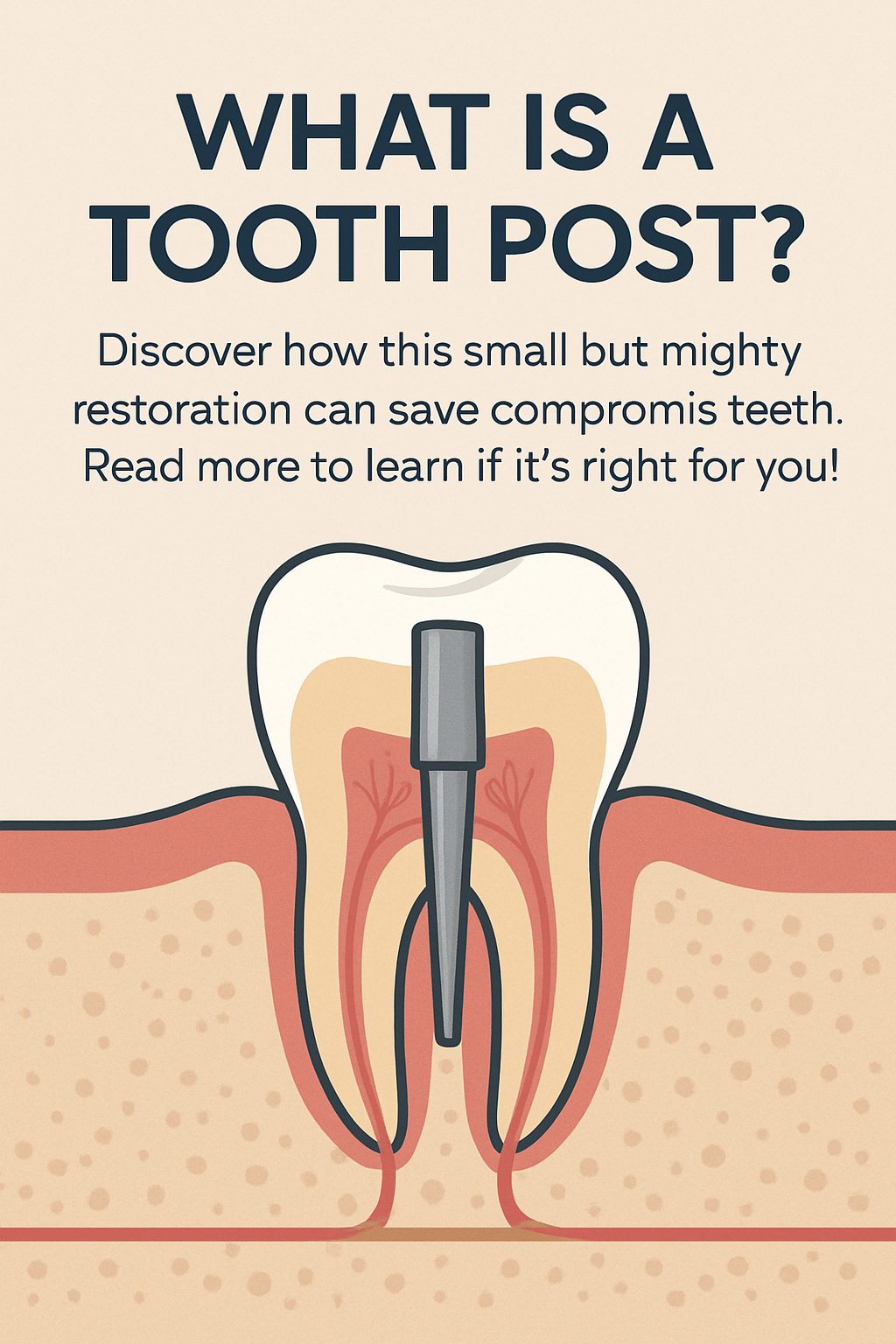
A tooth post is a small metal or fiber rod placed inside a tooth’s root after root canal treatment. It’s part of a post-and-core restoration. The post gives internal support, and the dentist builds a core around it to hold a crown securely.
Unlike a dental implant, which replaces the whole tooth root and crown with an artificial root and tooth, a tooth post keeps the original root. A post reinforces a weakened tooth so a crown can restore shape and function without removing the root.
When Is a Tooth Post Recommended?
After root canal treatment
When a tooth has had a root canal, the inside is hollowed out and may have lost much of its natural structure. A tooth post can be recommended to strengthen that tooth so a crown will stay in place and handle normal chewing forces.
To rebuild broken or weakened teeth
If decay, fracture, or previous fillings have left little tooth structure above the gum line, a post plus a core can rebuild the tooth to the right shape for a crown. In many cases this prevents extraction and preserves the natural tooth root.
When a tooth post is not the right choice
- Root is severely damaged, cracked, or fractured.
- Active infection that cannot be resolved with root canal retreatment.
- Insufficient root length or poor root shape to hold a post safely.
- When the tooth is better replaced by an implant due to long-term prognosis.
Procedure, Recovery, Risks, and Lifespan
Here are the typical steps for placing a tooth post and restoring the tooth:
- Post space preparation: dentist removes some root filling to create space for the post.
- Post placement: a prefabricated or custom post is inserted and cemented inside the root.
- Core build-up: material is added around the post to recreate tooth shape.
- Crown placement: after the core is shaped and impressions taken, a permanent crown is placed.
Recovery is usually mild. You may have temporary sensitivity or soreness for a few days. Follow these simple home-care tips:
- Avoid very hard or sticky foods on that tooth until the crown is secure.
- Maintain good oral hygiene with brushing and flossing around the crown.
- Report increasing pain, swelling, or looseness to your dentist right away.
Common risks and signs of failure include:
- Root fracture from biting forces — may cause sudden pain or tooth mobility.
- Post loosening or coronal failure — crown feels loose or falls off.
- Recurrent decay at the margin leading to sensitivity or infection.
How long a tooth post lasts depends on tooth position, chewing forces, quality of the restoration, and oral hygiene. With good care, many post-and-core restorations last 5–15 years or longer, but some fail sooner if the root weakens or fractures.
Costs, Alternatives, and Next Steps
Cost varies by dental office and the materials used. Generally:
- Post-and-core plus crown is often less expensive upfront than extraction plus dental implant.
- Dental implants have higher initial cost but can offer a longer-term solution when a root is not saveable.
Alternatives you may discuss with your dentist:
- Crown alone (if enough tooth structure remains).
- Onlay or inlay for smaller repairs.
- Extraction and replacement with a dental implant or fixed bridge.
Ask your dentist these questions when deciding between a tooth post and an implant:
- Is the root strong enough to support a post long term?
- What are the risks of root fracture or recurrent infection?
- How does cost compare for my situation, including future maintenance?
- What are the long-term success rates for a post-and-core vs implant here?
See your dentist as soon as you notice pain, looseness, or changes around a restored tooth. Early evaluation can often save the tooth or guide timely replacement.
Our dental team can evaluate your tooth with X-rays and an exam, explain whether a tooth post is appropriate, and outline implant or bridge options if needed. Schedule an exam to get a clear, personalized recommendation and next steps for care.

Teresa Salem, DMD
Dr. Teresa Salem is a recognized leader in dental implantology and same-day smile makeovers, having placed thousands of implants and completed hundreds of complex All-on-X cases. With nearly three decades of experience, she combines advanced technology, an in-house digital workflow, and patient-centered care to deliver efficient, high-quality treatment with greater affordability. A Diplomate of the International Dental Implant Association and nationally recognized speaker, Dr. Salem is trusted by both patients and providers for her clinical expertise and compassionate approach.